
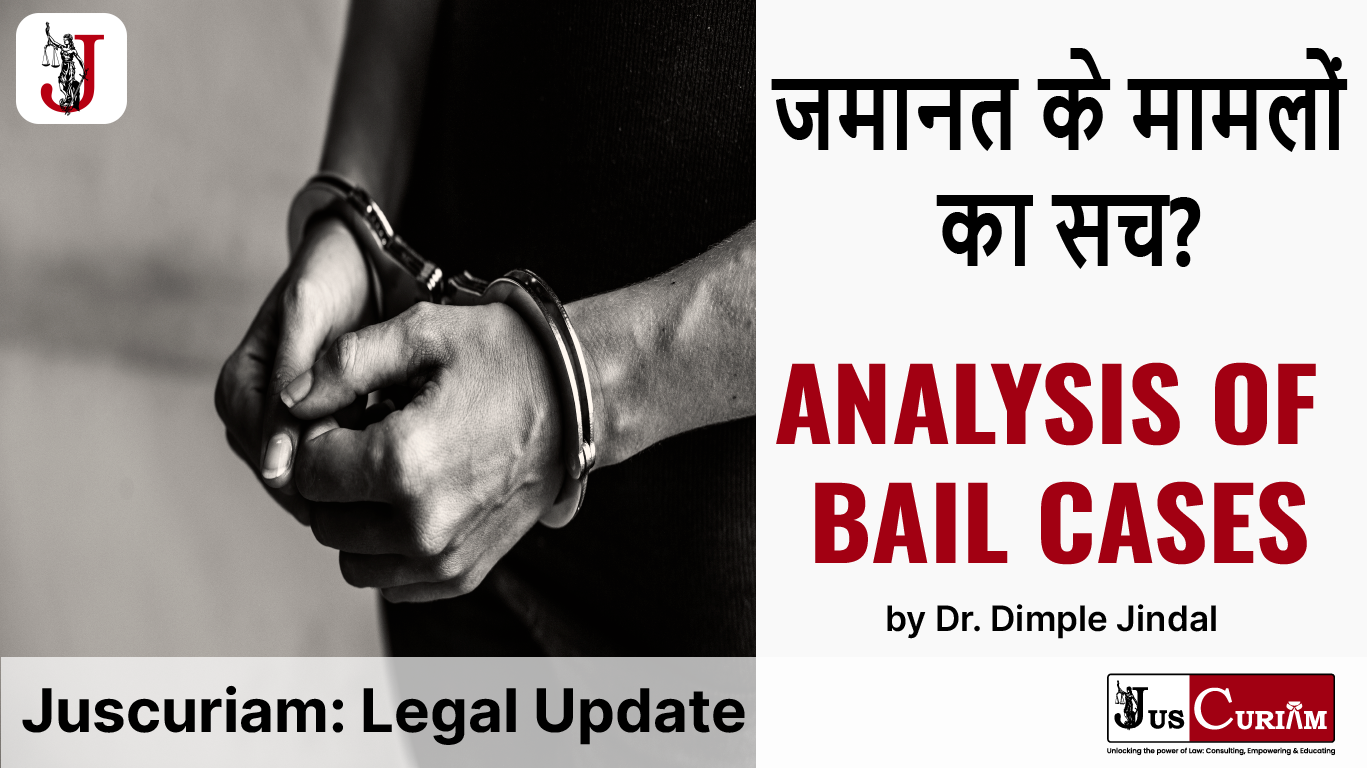
Bitter Truth of Bail Applications in All High Courts

Analysis of bail cases; Bitter truth of bail applications in all high courts

The outcome of the bail applications was unknown in 80% of the cases researched, and the exact act of the crime was not identifiable in more than 77% of the cases in which the persons were seeking bail.

Across all High Courts, DAKSH analyzed 9,27,896 bail cases that were filed between 2010 and 2021. The median days for the disposal of regular bail cases in the Jammu & Kashmir High Court were 156 days, for the Orissa High Court, 61 days, and for the Bombay High Court, 56 days.

Given the very high number of days it takes to dispose of bail cases (which are generally considered to not require much judicial time or deliberation), the lack of data to understand the reason for the delay is worrying. The data regarding the outcome of bail applications in High Courts was also missing.

In close to 80% of the disposed bail cases in all High Courts, the outcome of the bail appeal—whether it was granted or rejected—was either unclear, or missing, and surprisingly, this figure is 95% in the case of the Bombay High Court. This shows how the High Courts are working in our judicial system.

The State judiciaries are working arbitrarily with regards to the acceptance of bail applications. Many innocent persons are arrested on the basis of wrong F.I.R.s or complaints, and due to the non-consideration of bail applications in time, their right to liberty is badly affected, and their reputation is also tarnished in society. This is an irreparable loss for that person. Bail applications must be considered on a priority basis.

(*Source: Indian judicial data hides more than it reveals in bail cases—an article published in The Hindu, p. 7, August 14, 2023, Mohali edition and DAKSH’s ‘High Court Data portal.)

Article Reviewed by: Dr. Dimple Jindal

Go online for legal updates at www.juscuriam.com

Leave a Reply

Your email address will not be published. Required fields are marked *

Sample Mock Tests for Practice

The Hindu Marriage Act, 1955 (Paper 01: Q. 1 to 25)

HIMACHAL PARDESH LOWER JUDICIAL SERVICES 2011

THE COMPANIES ACT, 1956 (PAPER 01 Q. NO. 1 TO 19)

THE CODE OF CRIMINAL PROCEDURE, 1973 (PAPER – 08 Q. NO. 281 TO 320)

THE INDIAN CONTRACT ACT, 1872 (PAPER – 05 Q. NO. 141 TO 175)

MADHYA PARDESH LOWER JUDICIAL SERVICES 2019

HIMACHAL PARDESH LOWER JUDICIAL SERVICES 2014

THE CONSTITUTION OF INDIA, 1949 (PAPER – 16 Q. NO. 526 TO 560)

AILET – National Law University Delhi Entrance Test (NLU 2018)

THE INDUSTRIAL DISPUTES ACT, 1947 (PAPER 01 Q. NO. 1 TO 15)

THE CODE OF CRIMINAL PROCEDURE, 1973 (PAPER – 16 Q. NO. 601 TO 640)

THE INDIAN CONTRACT ACT, 1872 (PAPER – 10 Q. NO. 316 TO 350)

HIMACHAL PARDESH LOWER JUDICIAL SERVICES 2016-1

THE ADVOCATES ACT, 1961 (PAPER 01 Q. NO. 1 TO 10)

THE INDIAN EVIDENCE ACT, 1872 (PAPER – 10 Q. NO. 361 TO 400)

THE CODE OF CRIMINAL PROCEDURE, 1973 (PAPER – 19 Q. NO. 721 TO 760)

UTTAR PARDESH LOWER JUDICIAL SERVICES G.K. EXAM 2018

THE CONSUMER PROTECTION ACT, 1986 (PAPER 01 Q. NO. 1 TO 13)

THE CODE OF CIVIL PROCEDURE, 1908 (PAPER – 12 Q. NO. 441 TO 480)

THE SALE OF GOODS ACT, 1930 (PAPER – 01 Q. NO. 1 TO 35)

THE NEGOTIABLE INSTRUMENTS ACT, 1881 (PAPER 02 Q. NO. 41 TO 80)

THE MADHYA PRASESH LAND REVENUE CODE, 1959 (PAPER 02 Q. NO. 31 TO 44)

THE CODE OF CRIMINAL PROCEDURE, 1973 (PAPER – 07 Q. NO. 241 TO 280)

AILET – National Law University Delhi Entrance Test (NLU 2013)

THE INDIAN CONTRACT ACT, 1872 (PAPER – 02 Q. NO. 36 TO 70)

HARYANA LOWER JUDICIAL SERVICES 2018

THE INDIAN CONTRACT ACT, 1872 (PAPER – 06 Q. NO. 176 TO 210)

AIBE-XVI-2021-II (BCI-OCT-2021-SET-A) (ALL INDIA BAR EXAM 2021-II)

THE SPECIFIC RELIEF ACT, 1963 (PAPER – 01 Q. NO. 1 TO 35)

THE CODE OF CRIMINAL PROCEDURE, 1973 (PAPER – 22 Q. NO. 841 TO 870)

THE CONSTITUTION OF INDIA, 1949 (PAPER – 18 Q. NO. 596 TO 623)

THE LIMITATION ACT, 1963 (PAPER 02 Q. NO. 41 TO 80)

UTTARAKHAND LOWER JUDICIAL SERVICES 2002

DELHI LOWER JUDICIARY 2010