
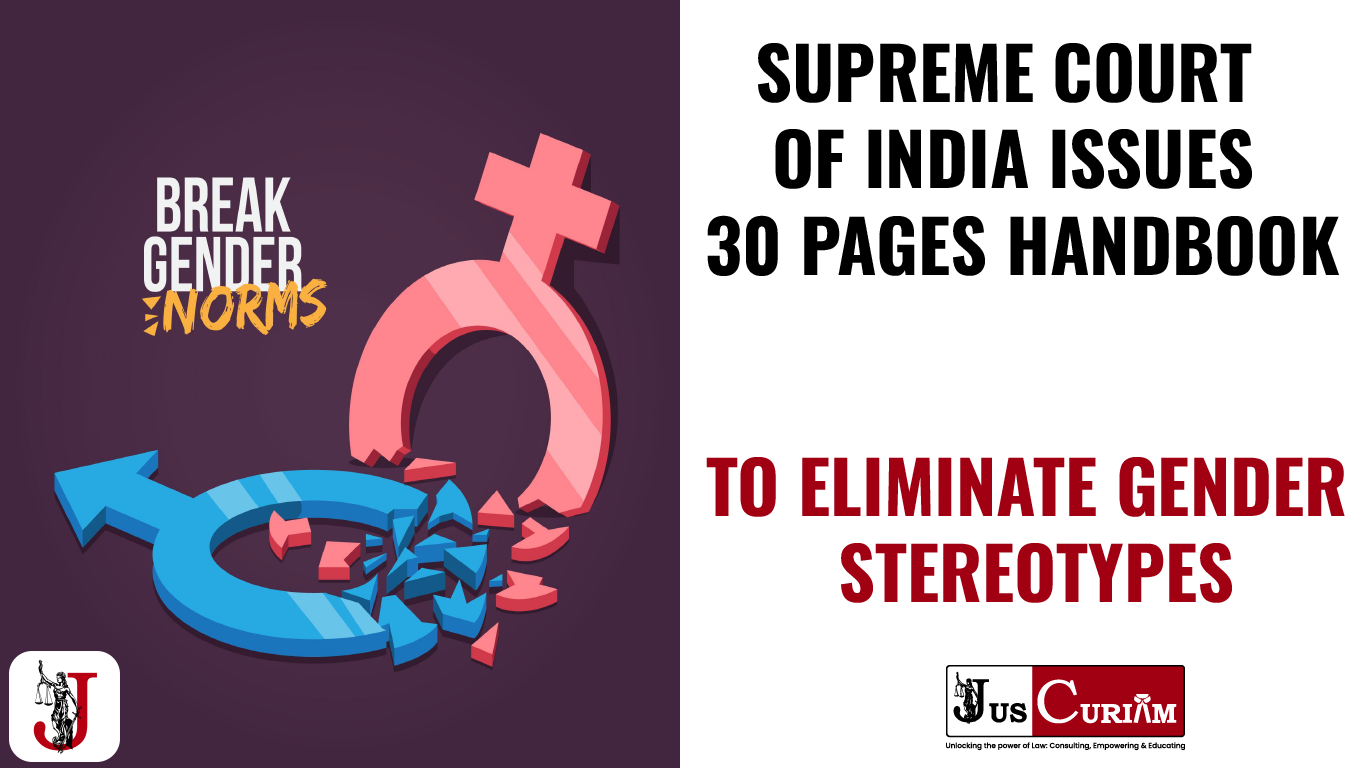
ELIMINATE GENDER STEREOTYPES – SUPREME COURT OF INDIA ISSUES 30 PAGES HANDBOOK TO ELIMINATE GENDER STEREOTYPES FROM INDIAN LAWS

SUPREME COURT OF INDIA ISSUES 30 PAGES HANDBOOK TO ELIMINATE GENDER STEREOTYPES FROM INDIAN LAWS

The Supreme court of India unveils a handbook of 30 pages to eliminate gender stereotypes from the Indian laws.

GENDER STEREOTYPES

The Supreme Court of India identified a number of words and phrases in Indian laws that leads to the gender stereotype society. 

Career woman, fallen woman, faithful or obedient wife, eve-teasing, hermaphrodite etc. are some words or phrases out of them. Supreme Court told that these are gender-unjust terms which are often heard in Indian courts. 

In a new handbook released by the top court offered the correct terms that should be used instead.

SUPREME COURT OF INDIA ISSUED 30 PAGES HANDBOOK

The 30-pages “Handbook on Combating Gender Stereotypes” aims to free the judiciary and the legal community from the mechanical application of gender stereotypical languages in judgments, orders and court pleadings. 

Chief Justice D. Y. Chandrachud foreword this handbook and said that he hoped the handbook would mark a significant milestone in the journey towards a more just and equitable society.

CHIEF JUSCTICE D. Y. CHANDRACHUD

Chief Justice further said that “I sincerely hope that this Handbook is widely read by all members of the legal profession in India to ensure that legal reasoning and writing is free of harmful notions about women. 

The Handbook will give a fresh impetus to our quest towards a gender-just legal order, and will be a crucial document to ensure that courts can deliver equal and impartial justice to individuals of all genders”. 

This handbook suggested to use “wife” only instead of several terms used at different times like “dutiful wife, faithful wife, good wife or obedient wife”. This book explains what stereotype means and how it affects the society. 

It defined stereotype “as a set idea that people have about what someone or something is like, especially an idea that is wrong.” Like any person, judges may also unconsciously hold or rely on stereotypes. 

If a judge relies on preconceived assumptions about people or groups when deciding cases or writing judgements, the harm caused can be enormous.

Go www.juscuriam.com for regular legal updates

*Source- The Hindu, August 17, 2023, p-1 & weblink – https://main.sci.gov.in/pdf/LU/16082023_073106.pdf

Leave a Reply

Your email address will not be published. Required fields are marked *

Sample Mock Tests for Practice

AILET – National Law University Delhi Entrance Test (NLU 2023)

THE CONSTITUTION OF INDIA, 1949 (PAPER – 04 Q. NO. 106 TO 140)

THE CONSTITUTION OF INDIA, 1949 (PAPER – 09 Q. NO. 281 TO 315)

UTTARAKHAND LOWER JUDICIAL SERVICES 2019

THE CODE OF CRIMINAL PROCEDURE, 1973 (PAPER – 03 Q. NO. 81 TO 120)

DELHI LOWER JUDICIAL SERVICES 2022

UTTARAKHAND LOWER JUDICIAL SERVICES 2002

THE SPECIFIC RELIEF ACT, 1963 (PAPER – 06 Q. NO. 176 TO 210)

THE INDIAN EVIDENCE ACT, 1872 (PAPER – 16 Q. NO. 601 TO 640)

THE INDIAN CONTRACT ACT, 1872 (PAPER – 07 Q. NO. 211 TO 245)

AIBE XVII 2023 (BCI-FEB-2023-SET-A) (ALL INDIA BAR EXAM 2023)

DELHI LOWER JUDICIAL SERVICES 2018-2

THE CODE OF CRIMINAL PROCEDURE, 1973 (PAPER – 06 Q. NO. 201 TO 240)

THE CODE OF CIVIL PROCEDURE, 1908 (PAPER – 21 Q. NO. 801 TO 840)

THE SPECIFIC RELIEF ACT, 1963 (PAPER – 07 Q. NO. 211 TO 231)

THE CODE OF CIVIL PROCEDURE, 1908 (PAPER – 16 Q. NO. 601 TO 640)

DELHI LOWER JUDICIAL SERVICES 2018(1)

THE CONSTITUTION OF INDIA, 1949 (PAPER – 17 Q. NO. 561 TO 595)

MADHYA PRADESH LOWER JUDICIAL SERVICES 2019(2)

THE INDIAN CONTRACT ACT, 1872 (PAPER – 03 Q. NO. 71 TO 105)

THE CONSTITUTION OF INDIA, 1949 (PAPER – 01 Q. NO. 1 TO 35)

THE CODE OF CRIMINAL PROCEDURE, 1973 (PAPER – 07 Q. NO. 241 TO 280)

THE CODE OF CIVIL PROCEDURE, 1908 (PAPER – 07 Q. NO. 241 TO 280)

THE INDIAN EVIDENCE ACT, 1872 (PAPER – 15 Q. NO. 561 TO 600)

THE INDIAN EVIDENCE ACT, 1872 (PAPER – 01 Q. NO. 01 TO 40)

THE LIMITATION ACT, 1963 (PAPER 06 Q. NO. 201 TO 240)

THE LAW OF ADMINISTRATION (PAPER 01 Q. NO. 1 TO 30)

THE CODE OF CIVIL PROCEDURE, 1908 (PAPER – 14 Q. NO. 521 TO 560)

THE SPECIFIC RELIEF ACT, 1963 (PAPER – 03 Q. NO. 71 TO 105)

HIMACHAL PARDESH LOWER JUDICIAL SERVICES 2019

THE LIMITATION ACT, 1963 (PAPER 05 Q. NO. 161 TO 200)

GUJRAT LOWER JUDICIAL SERVICES 2019

THE ARBITRATION AND CONCILIATION ACT, 1996 (PAPER 01 Q. NO. 1 TO 30)

THE CONSUMER PROTECTION ACT, 1986 (PAPER 01 Q. NO. 1 TO 13)

THE INDIAN CONTRACT ACT, 1872 (PAPER – 09 Q. NO. 281 TO 315)